
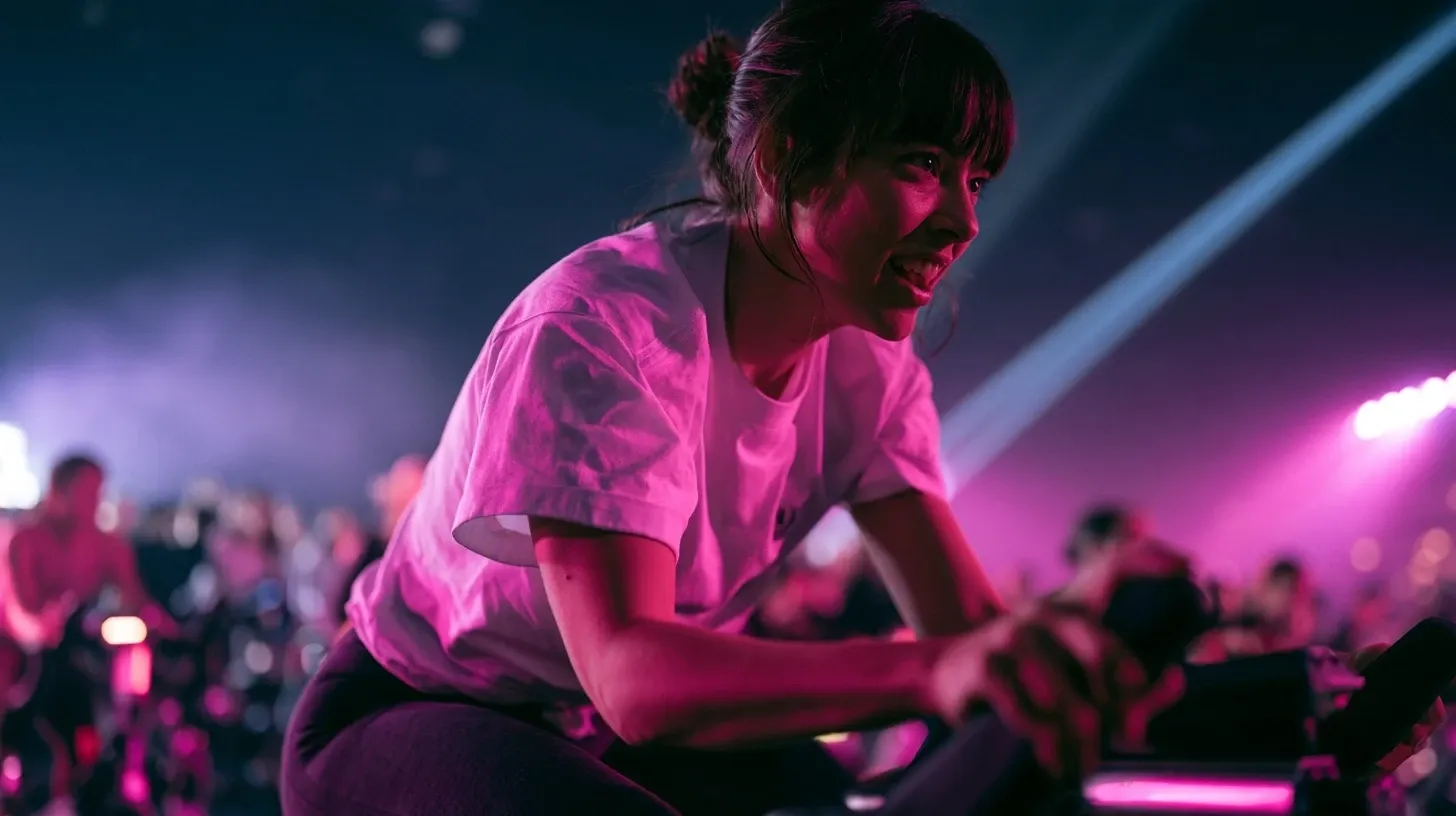
Cycling and interval training: music as fuel
With the music 10% faster, cyclists pedaled harder without noticing. In sprint intervals, it boosts both power and enjoyment.
Anyone who’s taken an indoor cycling class knows it: when a faster song comes on, the whole room speeds up. Studies show this is real, and that you can use it to your advantage.
Faster music, harder pedaling
In a 2010 English study (Waterhouse, Hudson and Edwards), cyclists rode for about 25 minutes at whatever pace they liked, listening to a playlist of popular songs. The twist: without them knowing, on each day the playlist played at normal speed, 10% faster or 10% slower.
- With faster music, they chose to pedal harder: more power and more distance covered.
- With slower music, power dropped by almost 10%, and they liked the music a lot less.
Music shapes the pace you choose, even when you don’t notice. That’s exactly what OmniBeat does on purpose, block by block.
On the bike with OmniBeat, every beat is a foot pushing down
The rule on the bike is simple: every beat is one foot pushing down on the pedal. Music at 170 BPM equals 85 pedal revolutions per minute, a fast ride on the flat.
This has an interesting consequence: on a climb with resistance, you pedal slower and harder, so the music gets slower right in the toughest stretch. In the Mountain workout, for example, each climb comes at a slower tempo than the one before, with more resistance. That’s why each block also shows the expected effort, from 0 to 10, and a short tip on what to do.
Music in sprint intervals
In interval training, music also proved its worth:
- In all-out 30-second sprints on the bike, music increased power and enjoyment of the workout (Stork and colleagues, 2015).
- Across 10 one-minute intervals, those who trained with continuous music finished the session with a better memory of the workout (Jones, Stork and Oliver, 2020).
- In a 2025 study (Karageorghis and colleagues), music increased motivation during the sprint session.
There’s a reason this matters: interval training is tough, and finishing with a good memory of it makes you want to come back next time.
How OmniBeat uses this
- A countdown before every change, with voice and vibration, so you start each sprint right on time.
- Tempo that follows the block, rising and falling gradually.
- Calmer music during recovery, so your body and mind can breathe.
Music is the fuel. The drive is yours, but the road there gets a whole lot more fun.
At the peak of effort, when your body is at its limit, your attention goes to your breathing and music matters less. But it’s before and after that moment that it makes a difference: in the motivation to start, in the rhythm of the blocks and in the desire to come back.
Sources
- Waterhouse J, Hudson P, Edwards B. Effects of music tempo upon submaximal cycling performance. Scandinavian Journal of Medicine & Science in Sports, 2010;20(4):662–669. doi:10.1111/j.1600-0838.2009.00948.x
- Stork MJ, Kwan MY, Gibala MJ, Martin Ginis KA. Music enhances performance and perceived enjoyment of sprint interval exercise. Medicine & Science in Sports & Exercise, 2015;47(5):1052–1060. doi:10.1249/MSS.0000000000000494
- Jones L, Stork MJ, Oliver LS. Affective responses to high-intensity interval training with continuous and respite music. Journal of Sports Sciences, 2020;38(24):2803–2810. doi:10.1080/02640414.2020.1801324
- Karageorghis CI et al. One-HIIT wonder: Can music make high-intensity interval training more pleasant? Psychology of Sport and Exercise, 2025;76:102717. doi:10.1016/j.psychsport.2024.102717